From Disorders of Consciousness to Independence: Sarah’s Brain Injury Recovery Story
Back to physical health resource hub
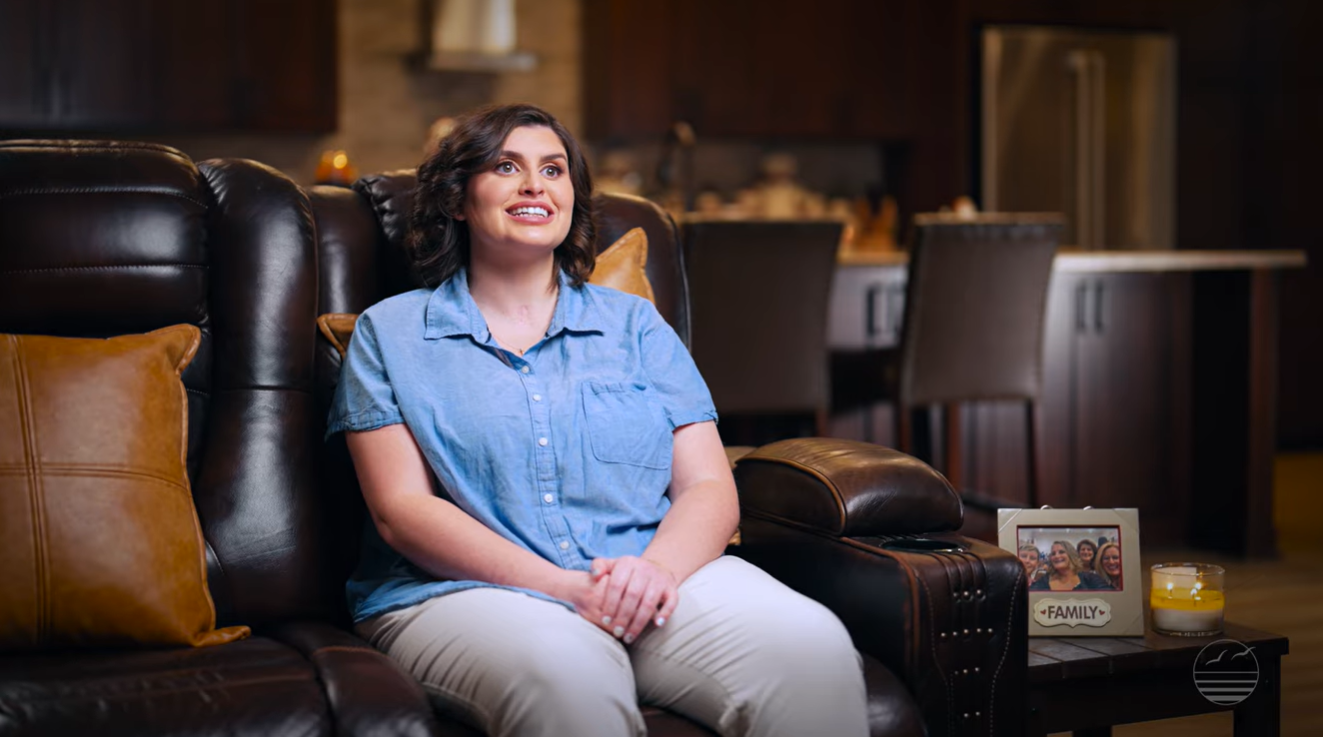
Sarah Giber is the kind of person everyone loves to be around. Outgoing, cheerful, and full of life, she has a special way of lighting up every room she enters. At just 23 years old, Sarah had big dreams of becoming a cosmetologist and one day owning her own salon. But one night in December of 2023, her life took an unexpected turn.
After weeks in the Intensive Care Unit, Sarah was transferred to Brooks Rehabilitation Hospital – University Campus to begin our Disorders of Consciousness (DoC) program. She spent 14 days there before being discharged home. At the time, Sarah remained in an unconscious state, which is common for DoC patients.
Over the course of five challenging months, Sarah underwent multiple surgeries and eventually emerged from her unconscious state. In May of 2024, she returned to Brooks Rehabilitation, this time for a nine-week inpatient stay. When she arrived, she couldn’t speak, walk or move independently. The road ahead of her was tough, but Sarah faced it with grace and determination. Week by week, Sarah defied the odds, grew stronger and began to make remarkable progress that was nothing short of a miracle.
Following her discharge, Sarah faced setbacks. Due to insurance limitations, she began therapy at an outpatient center that primarily focused on orthopedic care. Unfortunately, after a few weeks, she was discharged when the center determined she had “plateaued.”
Refusing to give up, Sarah’s parents, with the guidance of Brooks’ medical team, helped her transition to our Hudson outpatient clinic. There, Sarah’s progress soared. In just five weeks, she made incredible strides and started to regain her independence. Now, she’s back to embracing life, spending time with friends and walking over two miles a day.
Today, Sarah is back in Jacksonville, participating in the Brain Injury Day Treatment Program. Her goals are as big as her vibrant personality. She’s determined to return to cosmetology school and fulfill her dream of one day opening her own salon.
Transcript of Sarah Giber’s recovery story
Kelly:
12:30, between 12:30, one o’clock in the morning, there was this immense pounding on the door. I opened the door and he asked me if I knew a Sarah Giber and he was holding her driver’s license. So I said, “Yes, it’s my daughter.” And he said, “It’s been an accident over here on the expressway extension.” He didn’t really have any details. He couldn’t tell me what her condition was, but I knew that was very serious. And he kept asking if I was alone. And I told him my son was home and I told him my husband had just flown to Wisconsin. I said, “Is she alive?” “And ma’am, all I can tell you is you need to get to the hospital right now and call your husband.” So we drove to the hospital, my best friend and I, we have healthcare backgrounds.
So a nurse had come out and said, “We could see her. They have an ICU bed.” My son went right to Sarah and we just took a second and just viewed the room. We know that story that it tells after an emergency. And the scene was quite humbling even to the most trained healthcare professional, because I do that, I’ve done that in the past, I’ve taken care of those patients, I’ve set up those machines. When you walk in and it’s your child, it’s like all of that, that knowledge and information just drained out. And I was just her mommy. And it was 30 seconds. Someone came running through the room, said, “Say goodbye. She’s going to surgery.”
Dr. Persaud:
Initially, Sarah had a Glasgow Coma Scale of three, which is the lowest score that you can get. And immediately upon arriving to the ER, Sarah required an emergent craniectomy. What that is that they have to remove the skull in order to relieve the pressure due to the intense bleeding that was going on. So I think with Sarah’s injury specifically, time was of the essence.
Kelly:
Her GCS was a three, and so we’ve come to find out too, that’s essentially dead. They usually send those patients to the ER to pass away. All I could do was just the hardest thought I ever had in my entire life, I’ll let her go if it’s not going to be okay. And my friends were working overtime and my child is a stubborn miracle. She did not let me down. Nope. Every day I hoped she would wake up. It was day after day after day and you can’t stay in acute care ICU forever. So I started to begin to Google and figure out the next step. I Googled and found Brooks in Jacksonville. My preference was Brooks, because it was in Florida. I looked up their ratings. I looked up their reviews. I looked up their evidence-based data and I was like, “Okay, yes.”
Dr. Persaud:
So Sarah initially came in for our 14-day DOC or Disorders of Consciousness Program. We admit patients either in an unresponsive wakefulness state or minimal conscious state. Sarah came in a minimal conscious state. What does that mean? It means that she has a sleep wake cycle, but she’s not necessarily following commands consistently, not necessarily tracking consistently. Our goal in our disorders of consciousness program is to trial neurostimulants, provide caregiver education, and to ultimately get the patient the appropriate equipment to ultimately get home and to be able to have the time to emerge or to recover.
Kelly:
In the Disorders of Conscious Program, they still have the patient go to therapy and they work on some PT. They work on flexation, movement, muscles. They do OT. And in their OT and their speech cognitive sessions, they focus mostly on meaningful movement and trying to get the patient to make the cues that comes to tell them that they’re out of the coma, which is three consecutive days of a lot of little tests that they do. We didn’t get out of the disorders of conscious program at Brooks.
Dr. Persaud:
I always say is that when a patient comes in with disorders of consciousness, is this recovery is going to be a marathon, not a sprint? Rarely does a patient ultimately emerge within those 14 days. Our goal again is to try the neurostimulants to see if they can emerge, but as well as tolerate them so they can be discharged home on those medications. After Sarah left Brooks, I followed up with her via telemedicine several times. And during those times, we were adjusting medications, talking about different durable medical equipment, how can Sarah continue to benefit from therapies, things like that. I’ll never forget the day, I believe it was in May of 2024, so almost five months after Sarah’s injury, when Sarah pops up on this telemedicine and Sarah’s mom, Kelly, says, “Wave to Dr. Persaud.” And Sarah just puts her hands up and wave. And I’m like, “Oh my gosh, she’s emerged. She’s coming back to Brooks.”
Kelly:
So we went back up to Brooks. What we did there in the amount of time, it just kept getting better and better. And Dr. Persaud would just be like, “Keep going, keep going.” There was one day they were racing down the hallway in wheelchairs and wheely stools. I thought we’re going to get kicked out of here, “Better, stop, stop.” That is the best video. Here they come roaring down. Come on. Come on. OT was a big help with bathing, helping her get dressed a little more independently. They worked really hard and you could see things were starting to connect.
Sarah:
Dr. Persaud helped me so much and he believed in me that I could move again. My Brooks’ therapist helped so much walk and talk again and have more independence.
Dr. Persaud:
Initially, after leaving Brooks the second time, Sarah was connected with an outpatient therapy center that was very orthopedic-focused. They really didn’t understand the whole progression of brain injury recovery. And she was ultimately discharged several weeks after starting therapies, because they felt that she had began to plateau and that she didn’t need further therapies. As her brain injury physiatrist, I felt the complete opposite. I felt that she was making excellent progress, that she was only getting better and better and becoming more mobile. And thankfully through Sarah’s mom and myself advocating for her and getting her to another facility where she was at Brooks Rehabilitation Outpatient Center in Hudson, she was able to connect with an amazing neurotherapist named Abby.
Abby:
Clinically, when she came in, she was in a tilt and space wheelchair and she was all curled up in her wheelchair in kind of like a fetal position. She needed total assistance to be able to stand up, walk, sit on her own. She had strength, but she had no balance, coordination, safety awareness. And as we started to practice those specific tasks and functional tasks, she just started making significant progress immediately. And so we just kept pushing and pushing for more and more.
Kelly:
In five sessions, she had her out of that tilt and space wheelchair. They had her walking. I couldn’t believe it. That’s where the tears came.
Sarah:
In therapy, I noticed I was making progress. And at home, yes, I noticed I’m making progress. When I began to walk and talk again, that was so big, because walking was so big for me.
Kelly:
We had come on a different day and we ended up meeting Rachael. And so we kind of found the dream team for Sarah. Two female young therapists who figured it out the moment they met her, how to connect, how to get her buy-in. And they have done wonders, life-changing wonders.
Rachael:
Before her accident, she was in cosmetology school to become a hairdresser, so we knew that was one of her goals that she wanted to return to. When she first started, she could barely use her left hand for anything functional, but as soon as we put a hairbrush on her hand, she remembered what to do and how to move her hand. She wanted to learn how to wash her face on her own and do her skincare, which we met that goal and now she can do her makeup with all different tools.
Sarah:
Rachael helps me do hair often and also left-hand movement, like hand movements so I can hold hair tools again, like hair tools, like scissors and like hairbrushes and stuff like that.
Rachael:
When Sarah was having difficulties with her memory and her speech, she would go home and memorize the joke of the day, and now we have a joke of the day in the clinic.
Sarah:
Do you want to hear a joke? Why did the golfer bring two pairs of pants? In case he got a hole-in-one.
Rachael:
Sarah is everyone’s biggest cheerleader. When she walks in the room, she lights up the room. Everyone looks forward to seeing her come in. She loves to talk to people and celebrate people when they do even the slightest thing in therapy.
Sarah:
I spell the name. I say, “Give me an S, give me an A, give me an R, give me an A, give me an H.” I say, “No, give me a go, now give me a Sarah. And then give me a heck, give me a yeah. Now clap for Sarah. Listen, now everybody claps. Now I can. Now bow. Sarah bow, please.” How awesome, right?
Abby:
She now is able to walk on her own. We’ve recently started running and jumping. She goes on a walk every evening, which is something she did before her injury, and she takes her cat out on her little stroller and pushes the stroller down the road, which was a big goal for her.
Rachael:
We created a goal sheet so that she could visually see things that she needed to accomplish. And every time she would meet one of them, she would check them off and we’ve had to update the goal sheet quite a few times.
Dr. Persaud:
Sarah’s going to be starting our brain injury day treatment program, and we are so excited to see her progress to this stage. The day treatment program is for high-functioning brain injury patients who are starting to think about returning to work, returning to driving, trying to really get them into a more social setting. It’s group therapies.
Sarah:
I’m so excited to go back to Nashville and start their program. I’m excited to cook for the group. My goal is to go back to college at hair school.
Kelly:
It would have been easy to quit or to not give 100%, but this child is such a fighter. She took a circumstance and she met it head on.
Dr. Persaud:
Sometimes I sit back and I think about four years of undergraduate studies, four years of medical school, four years of residency, one year of brain injury rehabilitation fellowship, and nearly half a million dollars in student loan debt. And I see one patient like Sarah and I think, “Wow, this is all worth it.”
Kelly:
I and my husband, we just want her to find independence like she had before. To be able to provide for herself, have that independence, enjoy life. Extremely proud. She’s the reason I’m here and the reason I keep going.
Sarah:
Thank you guys so much for helping me walk again and become an individual and have more independence. Heck yes. I’m feeling more independent every day and also putting on my clothes. Heck yes, I love that I can brush my own hair again. Yay. I love I can go do all that and shower myself. Yay. I love, love, love. Yay. Do you want another one?
Interviewer:
Yes, I want to hear another joke.
Sarah:
Okay. Where did the cow get its medicine?
Interviewer:
Where did the cow get its medicine?
Sarah:
Farmacy, farmacy.
Interviewer:
Farmacy.