Q&A with Katelyn W. Jordan, OD, FAAO, FNAP
Back to physical health resource hub
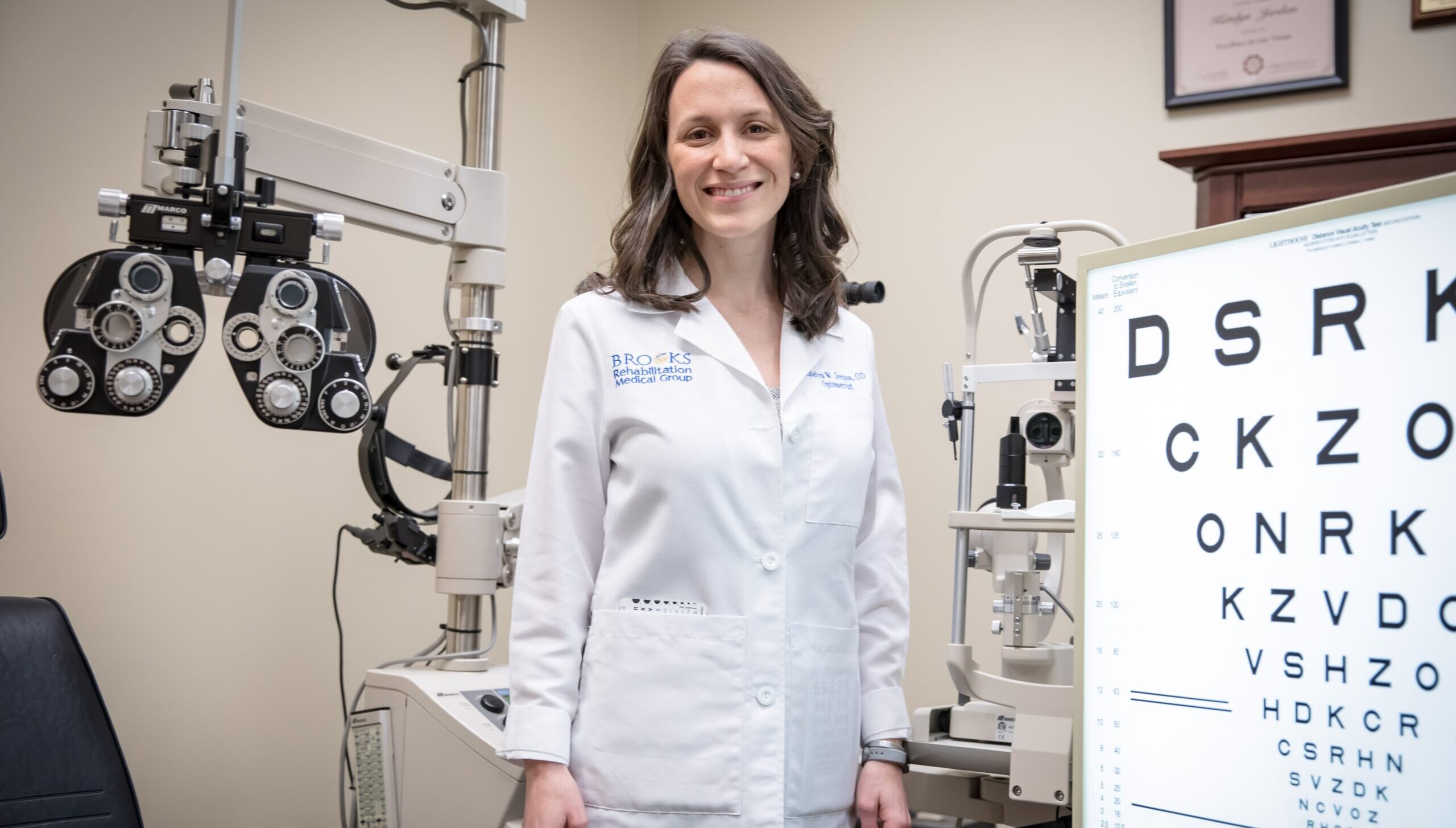
Katelyn W. Jordan, OD, FAAO, FNAP, director of Vision Rehabilitation Services, has been with Brooks for 12 years. Dr. Jordan graduated with her doctor of optometry, Magna Cum Laude, from the University of Houston, College of Optometry. She also holds a bachelor’s degree in exercise science from Florida State University. Dr. Jordan is a member of the American Academy of Optometry and the American Optometry Association. Dr. Jordan and has been honored with numerous awards, including the Reubin O’D Askew Young Alumni Award, Excellence in Low Vision Award, Presidential Graduate Fellowship, the Nelson Reber Eye Open Award and the Dr. A.C. Marcaccio Memorial Scholarship.
What is low vision?
“Low vision” is a very specific term that defines a loss of vision that cannot be corrected with regular glasses, contact lenses, medicine or surgery. Low vision is usually caused by eye diseases or health conditions, which can include age-related macular degeneration (AMD), cataracts, diabetes, glaucoma, traumatic brain injury and stroke. This type of vision loss can affect a person’s ability to participate in everyday activities.
How did you become interested in treating low vision patients?
In college I did an internship in the ophthalmology department at Mayo Clinic. I shadowed an optometrist and got to see the different specialties in optometry and ophthalmology. The optometrist did a low vision clinic once a week — and I found it to be unique in that every patient that came in had a different story, a different problem, and the way that it impacted their life was different. That meant that the way that we cared for them also had to be different. We had to take time to get to know the person, understand what they needed and then come up with a plan that was going to work specifically for them. That kind of personal level and creative problem solving really appealed to me.
What is the Center for Low Vision, how did it get started, and how did you get involved?
The Brooks Center for Low Vision is dedicated to helping individuals with vision loss regain the ability to participate in tasks that provide fulfillment and independence. It came about through donations by a community nonprofit, the Eye Research Foundation, for the purpose of making the low-vision services more well-known and more available. And at the same time a number of Brooks therapists were saying, “Hey, we’ve got these patients in rehab who have vision problems. It’s definitely impacting their rehab, and we don’t know how to deal with it.”
I was very familiar with Brooks and its reputation. I saw a position posted for a low-vision occupational therapist and thought, “Well, they’ll need an optometrist, too.” I met with some of the Brooks leadership and those involved with starting the Center, and we decided it was a good fit.
We learned together — me learning more about rehab and the rehab world, Brooks learning more about optometry and vision care, all to further what our patients need.
How is the Center special for an organization like Brooks?
It’s very unusual for a rehabilitation system like Brooks to treat low vision. Most of the time, you’ll find low-vision services in big ophthalmology departments or optometry schools. You’ll also find some private practice low-vision doctors. Often there will be a low-vision occupational therapist involved. But the depth of the system that Brooks has, and the low vision services inside of it, is what’s rare. We have a unique setup.
How does the Center function?
It is really more of a system-wide program now, functioning beyond the walls of the Center for Low Vision. In our inpatient hospitals, people are often admitted for a stroke or a brain injury. Somewhere between 60 to 70% of people with an acquired brain injury will experience an impact on their vision. So, as our therapists get them walking, taking care of themselves and doing well enough to go home, vision tends to be a really important piece. We have a vision rehab service in the hospital where initially every patient with a neurologic diagnosis gets screened for a visual impairment. All of our occupational therapists are trained to do the screening, and anyone on the team can request a consult from one of our optometrists to see the patient while they’re in our rehab hospital. We can follow up with discharged hospital patients in our outpatient clinic as well.
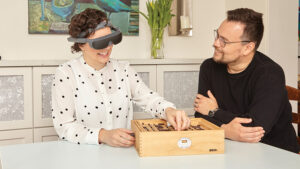
Outpatients generally come to us after their eye doctor or eye surgeon says, “There’s nothing more I can do.” It may get to the point that there’s nothing else that practice can do — because they may have no other services. But at Brooks, it’s not the end. The process usually starts with a low vision exam. This is how we determine any remaining vision and how it can be maximized. After that, our therapy team can then work with them to apply the recommendations for low vision glasses, magnifiers, technology and environmental adaptations to help them continue to manage their everyday activities — anything from brushing your teeth to managing your mail to taking your dog for a walk.
How has the Center grown?
We’ve recently hired Crystal Kasper, OD, as a consultative optometrist. She primarily sees our inpatient consults at our rehabilitation hospitals and skilled nursing facilities, while I now primarily see outpatients.
We’ve grown a whole inpatient “vision council” of therapists who take extra time to ensure that the vision screening is up to date, build up patient education, and make sure other team members who may not have as much vision screening experience have the resources they need. We are in the process of piloting a new site lead at the Brooks Rehabilitation Hospital – University Campus to improve the depth of interventions that are available for patients during their inpatient stay.
With outpatients, I’ve worked with our occupational therapist Sarah (Sarah J. LaRosa, OTD, MOT, OTR/L, SCLV, CLVT) for years, and we’ve added two more occupational therapists for outpatients, all of whom have advanced training in low vision, neurologic rehabilitation or both.
A new project that we added last year involves physical therapists with our program. We brought to Brooks a special “orientation and mobility” collaboration course for our physical therapists. People who have trouble getting around due to visual impairment will meet with an orientation and mobility specialist who teaches them white cane skills and safety skills. However, they don’t necessarily address other mobility issues. So, we’ve bridged the gap with physical therapists who can build patients’ balance and fall preventions skills and get them better prepared for the actual orientation and mobility training.
What would you say to those unfamiliar with Brooks’ Center for Low Vision?
What we’re doing at the Center for Low Vison is taking care of a person, not a set of eyeballs. Brooks has the resources to really help somebody’s mind, body and soul. We have adaptive sports to help them get back into some sort of activity — and they realize that they can still do recreational activities. We have our behavioral medicine department — psychologists to help you cope with the health changes that are dramatically affecting your vision and your life.
We’re still fighting this mentality that with vison loss — that’s the end. It’s not. If you injure a leg, we don’t leave you in a bed for the rest of your life. We fit you with braces. We give you physical therapy. We use wheelchairs, we use all kinds of devices so that you can still get around. And you’re not living isolated in a room. In a very similar way, when somebody has vision loss, we shouldn’t just leave them to figure out the world by themselves. We have so many people who could help them navigate it. There’s so much technology. There are so many different options to help them continue or learn to lead a more independent, a more fulfilling life.